
Can You Use Retinol and Vitamin C Together?
You have a vitamin C serum in one hand and a retinol cream in the other, and you are not sure if they belong in the same routine. You are not alone. This is one of the most common skincare questions, and the answers online often sound confusing.
Here is the clear answer: can you use retinol and vitamin C together? Yes, just not at the same time. Use vitamin C in the morning and retinol at night. This simple split gives each ingredient its best moment and keeps your skin calmer.
This guide explains why this works, how to start slowly, and what to do if your skin gets irritated. It also covers the myths, the right product types, and common mistakes. This is general information, not medical advice.
Quick answer: Yes, you can use retinol and vitamin C together – just not at the same time of day. Use vitamin C serum in the morning and retinol at night. This simple split keeps both ingredients effective while keeping irritation low. Start slowly (2-3 nights a week), moisturize well, and never skip sunscreen in the morning.
The Short Answer: Yes, With One Simple Rule
The rule is easy to remember: vitamin C in the morning, retinol at night.
This works because each ingredient has a different job:
- Vitamin C is an antioxidant. It helps protect your skin from daily stress, such as sunlight and pollution, so it makes sense to wear it during the day.
- Retinol helps your skin renew itself. It is best used at night, and it can make skin more sensitive to sunlight, so evening is the safer time.
You also get a bonus: using them at different times means your skin faces only one strong active at once. That makes it easier to see what is helping and what is causing trouble.
What Vitamin C Does for Your Skin
Vitamin C is one of the most popular skincare ingredients. In a serum, it is usually used for:
- Antioxidant protection: it helps defend skin against everyday environmental stress.
- Brighter-looking skin: it can help your tone look more even and fresh.
- Dark spots: it is often used to fade the look of marks left by sun or old spots. If this is your main goal, read our guide on vitamin C for pigmentation.
- Collagen support: it plays a role in your skin’s natural collagen process.
Vitamin C does not replace sunscreen. It works well with sunscreen, but it is not a substitute.
What Retinol Does for Your Skin
Retinol is a form of vitamin A. It is known for helping skin renew faster. People use it for:
- Cell turnover: it encourages older surface cells to be replaced by fresher ones.
- Fine lines: it can soften the look of early lines over time.
- Texture and pores: skin can feel smoother, and pores can look less obvious.
- Collagen: it supports skin firmness over the long term.
Retinol is strong. In the first weeks, dryness, redness, or flaking can happen. This is why a slow start matters, and why we spend so much of this guide on gentle schedules.
Why They Work Better as a Team
Vitamin C and retinol do different things, so together they cover more ground than either one alone.
- Vitamin C protects and brightens during the day.
- Retinol renews and smooths while you sleep.
Together, they may help with tone, texture, dark spots, and the look of ageing. They also fill each other’s gaps: vitamin C does not speed up cell turnover, and retinol does not give the same antioxidant cover.
One study worth knowing: Herndon and colleagues (2016, published in the Journal of Drugs in Dermatology) tested a moisturizer containing 0.5% retinol and 30% vitamin C on people with hyperpigmentation and sun damage. As reported, improvements appeared between 4 and 12 weeks, and some people had mild dryness at the start. This is one study with a specific product, so do not treat it as a promise for every serum.
The Myth: Why People Say You Should Never Mix Them
You may have heard that these two ingredients clash. There is a small truth behind this, and a bigger misunderstanding.
Where the pH story came from
Pure vitamin C (called L-ascorbic acid) works best in a very acidic product, usually around pH 3.5 or lower. Retinol is usually happier in a product closer to pH 5 to 6. So when the two are layered together, one of them may not work as well as it should.
This is true mainly for pure L-ascorbic acid. Many modern vitamin C products use gentler, more stable forms, and those are less affected by this problem.
The tolerance truth
The other reason is simpler. Two strong actives used at once can overwhelm skin, especially if you are new to them. Many people who said they clashed were probably doing too much, too fast. The redness and stinging came from overload, not from a secret chemical reaction.
Why the AM/PM split solves both problems
Splitting them across the day fixes the issue in four ways:
- Right timing: each one is used when it is most useful.
- Lighter workload: your skin barrier handles one strong active at a time.
- Easy troubleshooting: if your skin reacts, you can tell which product is likely to blame.
- Easier habit: a simple morning and night routine is easier to repeat.
A quick note on trust: drug-interaction checkers discuss vitamin A and vitamin C pills you swallow. This guide is only about serums and creams you put on your skin.

Can You Use Retinol and Vitamin C Together? 3 Safe Ways
Method 1: Vitamin C in the morning, retinol at night (recommended)
This is the easiest and most popular method. Vitamin C goes on after cleansing in the morning. Retinol goes on at night. Nothing overlaps.
Method 2: Alternating nights
Use vitamin C on one day and retinol on the next. This is helpful if your skin is very sensitive and even the AM/PM split feels like too much. The downside is that you get each ingredient less often.
Method 3: Same night, 30 minutes apart
Apply vitamin C first, wait about 30 minutes, then apply retinol. Vitamin C goes first because it is usually the more acidic product. This works for some people, but it is not the best default. You also lose the daytime antioxidant protection, and your skin takes on two strong actives in one evening.
Comparing the three methods
| Method | How easy is it? | Irritation risk | Best for |
|---|---|---|---|
| 1. Vitamin C AM, retinol PM | Very easy | Lower | Most people, especially beginners |
| 2. Alternating nights | Easy | Lowest | Sensitive skin or a very cautious start |
| 3. Same night, 30 minutes apart | More work | Higher | Experienced users with a reason to use both at night |
Opinion: For most beginners, the AM/PM split is the better choice than layering both in one night, because it is simpler to stick to and easier to troubleshoot if irritation appears.
If you want to know more about evening vitamin C, see our article on using vitamin C serum at night. For a full picture of product order, read the correct layering order.
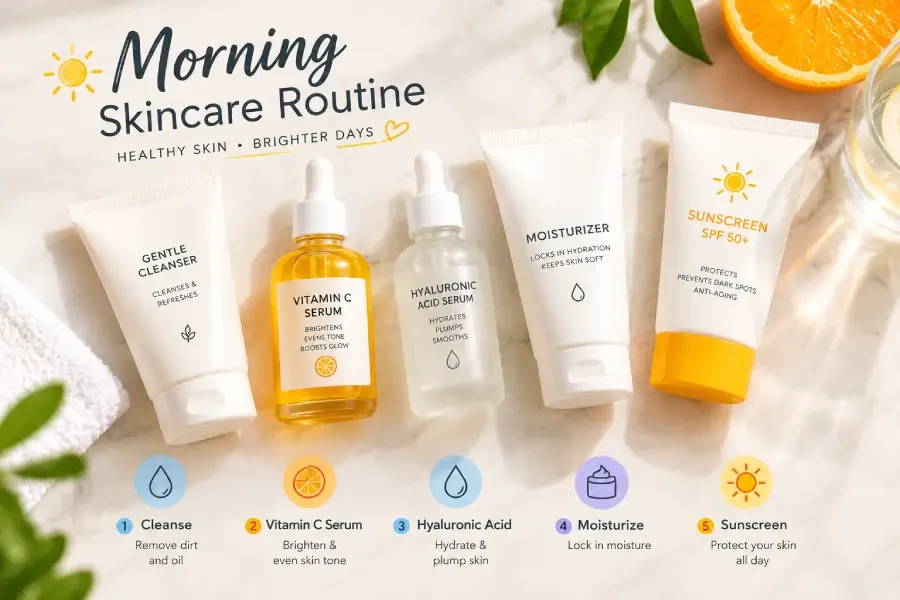
Your Morning Routine, Step by Step
- Cleanse. Use a gentle cleanser and pat your face dry.
- Vitamin C serum. Apply a few drops to clean, dry skin. Follow the directions on your product.
- Hydrating serum (optional). A hyaluronic acid serum adds moisture if your skin feels tight.
- Moisturizer. This helps lock everything in.
- Sunscreen. Use it every single day, even when it is cloudy. Vitamin C and sunscreen work best as a pair, and retinol makes sun protection even more important.
Your Night Routine, Step by Step
- Cleanse thoroughly. If you wore makeup or sunscreen, cleanse twice (a double cleanse).
- Let your skin dry completely. Retinol on damp skin can sink in faster and sting more. Wait a few minutes.
- Apply retinol. A pea-sized amount is enough for the whole face. Keep it away from the eye area, corners of the nose, and corners of the mouth.
- Moisturizer. Apply it to seal in moisture and keep skin comfortable.
On nights when you do not use retinol, skip it and use a hydrating serum and moisturizer instead.
The 8-Week Beginner Schedule (Start Here)
Beginners often do too much too fast. This slow plan gives your skin time to adjust. Move to the next step only if your skin feels comfortable. If it does not, stay where you are for another week.
| Weeks | Morning | Night |
|---|---|---|
| 1-2 | Vitamin C every morning, then sunscreen | Retinol 1-2 nights a week, not on back-to-back nights |
| 3-4 | Same | Retinol 2-3 nights a week if skin feels comfortable |
| 5-6 | Same | Retinol every other night |
| 7-8 | Same | Nightly only if your skin is truly happy |
Many people never go nightly, and that is fine. Using retinol 4 to 5 nights a week can work well for the long term.
Off nights are recovery nights, not empty nights. Use a hydrating serum and moisturizer, or a gentle niacinamide product if your skin likes it.
New to vitamin C as well? Start it first, use it for one to two weeks, then add retinol. Adding one new product at a time helps you spot problems early. Do a patch test before using any new product on your face. One way is to apply a small amount to your inner arm or behind the ear, and watch the area for several days.
The Sandwich (Buffering) Method for Sensitive Skin
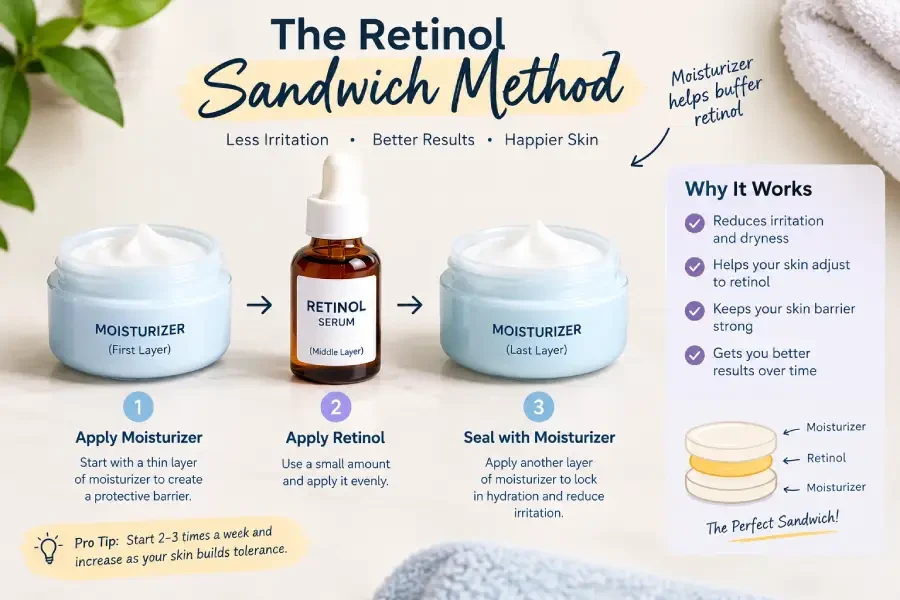
Buffering means putting a layer of moisturizer around retinol to soften how it feels. It slows how fast retinol reaches your skin, but it does not change the strength of the product.
There are two easy versions:
Version 1: Moisturizer first.
- Cleanse and dry your face fully.
- Apply a thin layer of moisturizer.
- Wait a few minutes.
- Apply your pea-sized retinol on top.
Version 2: The moisture sandwich.
- Apply a light hydrating layer.
- Apply retinol.
- Finish with moisturizer.
The sandwich can help you stay consistent, which matters more than going fast.
Guide by Skin Type
Start lower than you think you need. You can always go up later.
| Skin type | Retinol approach | Vitamin C approach |
|---|---|---|
| Sensitive | Lowest strength, sandwich method, 1 night a week to start | Gentler vitamin C form (see next section) |
| Dry | Richer moisturizer, fewer nights, add hyaluronic acid | Gentle or hydrating formula |
| Oily or acne-prone | Lighter textures, often tolerates the standard plan | Lightweight serum, but still go slowly |
| Combination | Treat zones differently if needed, such as fewer applications on dry cheeks | Standard serum |
Note: if you have acne, eczema, rosacea, or any skin condition, check with a dermatologist before starting retinol.
Vitamin C Forms Compared (Which Pairs Best With Retinol?)
Not all vitamin C is the same. The form changes how strong, stable, and gentle the product is.
| Form | Strength | Stability | Gentleness | Good for |
|---|---|---|---|---|
| L-ascorbic acid | Strongest | Least stable | Most demanding | Experienced users, normal or oily skin |
| Sodium ascorbyl phosphate | Moderate | More stable | Gentler | Beginners, acne-prone skin |
| Tetrahexyldecyl ascorbate | Moderate | Stable | Gentle | Sensitive or dry skin |
| Ascorbyl glucoside | Milder | Stable | Gentle | Sensitive skin, easy pairing |
For most beginners using retinol, a gentler form is a sensible choice. It is easier on the skin and less likely to cause irritation when you are also starting retinol. Which form a brand uses is listed in the ingredient list.
The Retinoid Strength Ladder
Retinol is part of a family called retinoids. They differ in strength:
- Retinol: a common over-the-counter form. Many people start here, often at a low strength.
- Retinal (retinaldehyde): works faster because it is closer to the form your skin uses. It can be stronger on the skin.
- Prescription tretinoin: the strongest, available through a doctor.
The higher you go, the more careful you should be with other actives. If you use a prescription retinoid, follow your doctor’s advice first and ask before adding vitamin C. The AM/PM split is the safest pairing at every level.
The pH Explanation in Plain Language
pH measures how acidic or alkaline something is. Lower numbers are more acidic.
- Pure L-ascorbic acid works best at about pH 3.5 or lower.
- Retinol is typically formulated nearer to pH 5 to 6.
When you apply them together, the acidic product can change the conditions for the other. That may lower how well one or both work, and it can also bother your skin. This is why the 30-minute wait is often suggested for same-night use: it gives the first product time to settle in before the second goes on. The exact effect depends on the actual formulas, so this is a general guide, not a guarantee.
What NOT to Use on Retinol Nights
Retinol already speeds up skin renewal. Adding more strong products can overload your barrier. On retinol nights, avoid:
- AHAs and BHAs (such as glycolic or salicylic acid)
- Benzoyl peroxide
- Scrubs and other harsh exfoliants
Here is a simple weekly planner for a three-night schedule:
| Day | Morning | Night |
|---|---|---|
| Monday | Vitamin C + sunscreen | Retinol |
| Tuesday | Vitamin C + sunscreen | Recovery (hydrating serum, moisturizer) |
| Wednesday | Vitamin C + sunscreen | Retinol |
| Thursday | Vitamin C + sunscreen | Recovery |
| Friday | Vitamin C + sunscreen | Retinol |
| Saturday | Vitamin C + sunscreen | Recovery |
| Sunday | Vitamin C + sunscreen | Recovery |
If you want an exfoliating acid in your routine, use it on a recovery night, and only if your skin is calm.
10 Common Mistakes to Avoid
- Mixing both in your palm. Layer them at different times instead.
- Starting both on day one. Add one new product at a time.
- Skipping sunscreen. Retinol and sun are a poor match without protection.
- Using oxidised vitamin C. If it has turned yellow or brown, it may have gone off. Replace it.
- Choosing jar packaging. Air gets in each time you open it. Opaque bottles with pumps or droppers are better.
- Applying retinol to damp skin. It can sting more. Dry skin first.
- Using too much. A pea-sized amount is enough. More does not mean faster results.
- Going nightly too fast. Follow the schedule above.
- Layering makeup or sunscreen over retinol. Retinol belongs in your night routine, not under daytime products.
- Giving up after one week of flaking. Mild adjustment can happen. If it is only mild, slow down rather than quit.

What to Do If Irritation Happens (Rescue Plan)
If your skin burns, turns very red, or feels raw, follow these steps.
- Pause your actives. Stop retinol, vitamin C, and exfoliating acids.
- Repair the barrier. Use a gentle cleanser, a ceramide moisturizer, and sunscreen in the day. Nothing else.
- Wait for skin to calm. This can take several days, sometimes longer.
- Restart slowly. Bring back vitamin C first, then retinol at 1 night a week, then build up again.
- Adjust. Try a lower strength, the sandwich method, or a gentler vitamin C form.
Normal adjustment vs real irritation. Mild dryness or light flaking that settles is often part of getting used to retinol. Stinging, burning, swelling, or a rash is not a normal adjustment, so stop and see a doctor or dermatologist if it does not improve.
How Long Until You See Results? (Honest Timelines)
Nobody can give you an exact date. Results depend on your formula, your skin, and how steady you are. As a general guide:
- Brightness: may show first, often within weeks of consistent use.
- Dark spots: usually take longer.
- Fine lines and texture: often take the longest.
As a reference point, the Herndon 2016 study reported improvements between 4 and 12 weeks. Real-life results vary, so be patient and keep using sunscreen.
For a deeper look at fading marks, see our article on vitamin C for pigmentation.
Pregnancy and Breastfeeding
No retinoid product is considered safe during pregnancy. That includes retinol and prescription retinoids. Vitamin C is generally considered fine on the skin, but please confirm with your doctor before using any new skincare products during pregnancy or breastfeeding.
If you are pregnant, planning to become pregnant, or breastfeeding, speak with your doctor or a dermatologist before you continue retinol. This section is general information and not medical advice.
Can you use retinol and vitamin C together?
Yes, but not at the same time. Vitamin C in the morning and retinol at night is the simplest and most commonly recommended way.
Can you use vitamin C and retinol on the same night?
It is possible. Apply vitamin C first, wait about 30 minutes, then apply retinol. It is not the best choice for beginners, because it asks more of your skin and removes the daytime benefit of vitamin C.
Which goes on first, vitamin C or retinol?
If you must use both in one routine, vitamin C goes first because it is usually more acidic. In an AM/PM routine, you do not need to worry about order because they are used at different times.
Can you mix retinol and vitamin C in your hand before applying?
It is better not to. Mixing changes how the products behave and can raise irritation risk. Apply them separately, ideally at different times of day.
Can beginners use retinol and vitamin C together?
Yes, with a slow start. Begin with vitamin C in the morning, then add retinol one or two nights a week. Follow the 8-week schedule above.
Can you use retinol in the morning?
It is usually better at night. Retinol can make skin more sensitive to the sun, so evening use with daily sunscreen the next day is safer.
Can you use hyaluronic acid or niacinamide with retinol and vitamin C?
Hyaluronic acid is generally gentle and can be used in both your morning and night routines. Niacinamide is often used on recovery nights and may help skin feel comfortable. If your skin is sensitive, add one product at a time.
How long should you wait between vitamin C and retinol?
If you use both in one routine, a wait of about 30 minutes is a common suggestion. A simple AM/PM split removes the need to wait.
Conclusion
The answer is simple: can you use retinol and vitamin C together? Yes, by giving each one its own time. Vitamin C goes on in the morning with sunscreen, and retinol goes on at night.
Start slowly, add one product at a time, and let your skin set the pace. If irritation happens, pause, repair your barrier, and restart gently. If you are pregnant, breastfeeding, or your skin does not settle, speak to a doctor or dermatologist.
For related reading, see the correct layering order and vitamin C for pigmentation.