Vitamin C Serum at Night: 7 Benefits, Uses & Routine
Vitamin C Serum at Night
Using vitamin C serum at night is one easy way to add an antioxidant and brightening ingredient to your skincare routine. Vitamin C, especially L-ascorbic acid, has been studied for its antioxidant activity, role in collagen production, and potential to improve the appearance of uneven pigmentation and signs of photoaging. Although vitamin C is often recommended as a morning skincare ingredient because it can complement sunscreen, it can also be used at night.

The key is not simply applying a vitamin C serum before bed and expecting instant results. Your skin usually benefits more from a consistent routine, an appropriate formulation, and careful product layering. If you are new to vitamin C, understanding when to apply it, what products to use with it, and which combinations may cause irritation can make the process easier.
Is Vitamin C Good for Fading Pigmentation?
A skincare product containing vitamin C or a vitamin C derivative is commonly called a vitamin C serum. One of the best-known forms is L-ascorbic acid, also known as ascorbic acid. Other products use vitamin C derivatives that are designed to improve stability or make formulation easier.
Vitamin C is an antioxidant, meaning it can help protect the skin from oxidative stress caused by unstable molecules known as free radicals. In skincare, topical vitamin C has been investigated for several purposes, including supporting collagen formation, helping reduce the appearance of pigmentation, and protecting the skin from environmental oxidative stress.
Vitamin C serum can be a useful part of a well-planned skincare routine. If you want to learn more about building a healthy skincare routine, read our guide to Skin Regimen: 7 Powerful Tips for a Healthy-Looking Skin Routine.
However, not every vitamin C serum works in exactly the same way. The concentration, form of vitamin C, formulation, pH, packaging, and stability can all affect how a product performs. This is one reason choosing a product based only on the words “vitamin C” on the label may not be enough.
Is Vitamin C Serum Safe to Use at Night?
Yes, vitamin C serum can be used at night. There is no general rule saying vitamin C must only be applied in the morning. Nighttime application can be particularly convenient for people who have a busy morning routine or prefer introducing vitamin C gradually.

Vitamin C does not need sunlight to work on the skin, so applying it before bed is a reasonable option. However, nighttime vitamin C cannot replace daytime sun protection. If you are using vitamin C for concerns such as dark spots, uneven skin tone, or photoaging, daily sunscreen remains an important part of your overall routine.
Some dermatology guidance favors morning use because topical vitamin C can complement sunscreen as part of an antioxidant-focused daytime routine. That does not make nighttime use wrong; it simply means that the most convenient time can depend on your routine and the other products you use.
Why Should You Use Vitamin C Serum at Night?
Using vitamin C consistently may support several common skincare goals. Research on topical vitamin C has examined antioxidant protection, collagen-related effects, pigmentation, and signs of photoaging.
Brightens the Appearance of Dull Skin
One reason people search for vitamin C serum at night is to improve the appearance of dull or uneven-looking skin. Vitamin C is commonly used in skincare formulas designed to promote a brighter, more even-looking complexion.
The effect is not usually something you should expect to see after one application. Skin changes take time, and results can vary depending on the formulation, concentration, skin type, and specific concern being addressed.
Helps Reduce the Appearance of Dark Spots
The effect of topical vitamin C on melanin formation and pigmentation has been investigated. Some clinical research has reported improvements in pigmentation after topical vitamin C use, although the available evidence varies between formulations and studies.
If dark spots are your main concern, vitamin C can be one part of a broader skincare routine rather than the only product you use. Because prolonged UV exposure can contribute to pigmentation, sun protection is especially important when trying to maintain a more even-looking complexion.
Supports Collagen Production
Vitamin C has an important role in collagen synthesis. Collagen helps provide structure and support to the skin, and collagen production naturally changes with age.
This is one reason vitamin C is commonly included in skincare routines that aim to improve the appearance of fine lines and photoaged skin. However, a serum is not a replacement for professional treatment, and visible changes generally require consistent use over time.
Provides Antioxidant Support
Daily environmental exposure may contribute to oxidative stress in the skin. UV radiation and pollution are among the factors associated with oxidative damage.
Topical vitamin C has antioxidant properties, which is one of the main reasons it is widely used in skincare. Using it at night can still provide the benefits associated with topical vitamin C, even though many people prefer to use antioxidant products during the day.
Vitamin C Serum at Night vs. Morning
Both morning and nighttime application can make sense, but the best choice depends on your routine and the product you use.
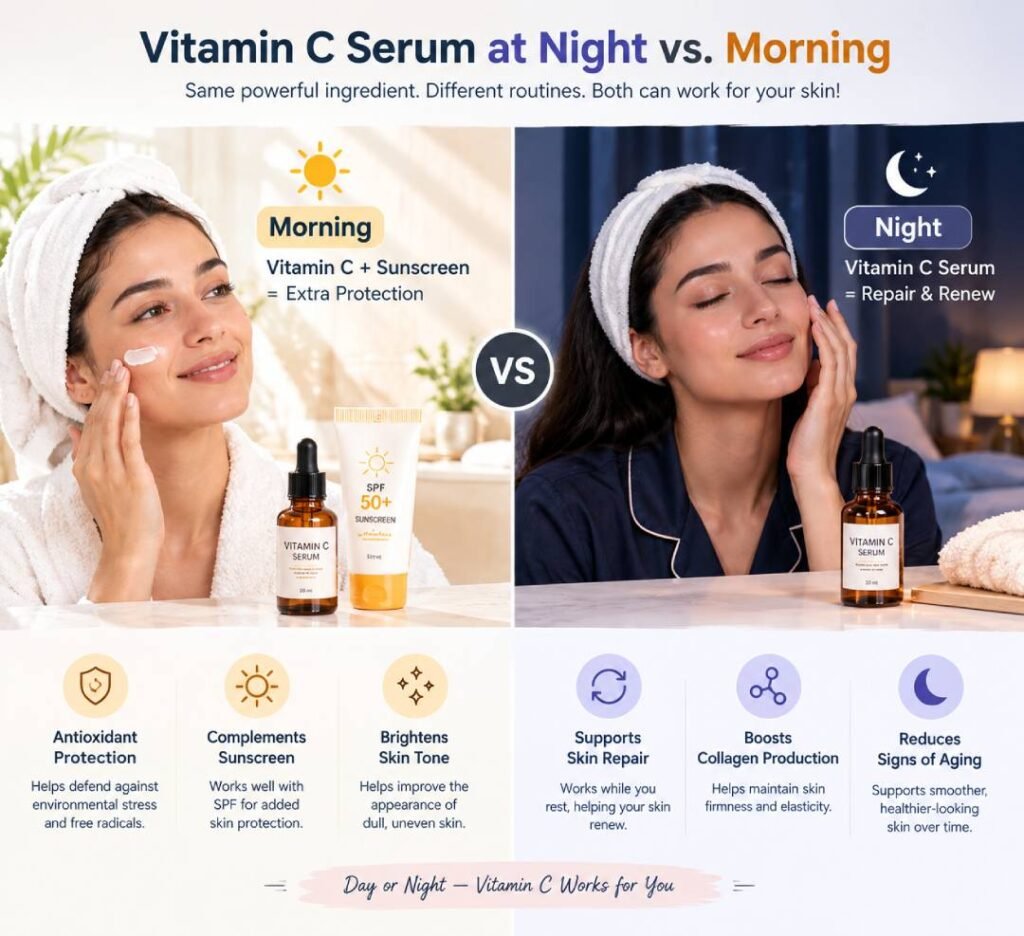
| Feature | Vitamin C in the Morning | Vitamin C at Night |
|---|---|---|
| Antioxidant skincare | Yes | Yes |
| Can support brighter-looking skin | Yes | Yes |
| Can be used with moisturizer | Yes | Yes |
| Sunscreen can follow | Yes | No |
| Convenient for simple routines | Often | Often |
| May suit people with busy mornings | Sometimes less convenient | Often convenient |
| Replaces sunscreen | No | No |
Morning use has a practical advantage because vitamin C can complement sunscreen. Nighttime use, on the other hand, may make your routine easier if you prefer applying active ingredients before bed.
There is no need to force yourself into a complicated routine simply because a product is traditionally marketed as a morning serum. Consistency is an important part of skincare, so the best time may be the one you can comfortably maintain.
How to Use Vitamin C Serum at Night
A simple nighttime routine does not need to contain many products. If you are a beginner, start with a basic sequence and introduce active ingredients gradually.
Step 1: Cleanse Your Face
Begin by cleansing your skin with a gentle cleanser. The purpose is to remove makeup, sunscreen, oil, sweat, and everyday buildup without unnecessarily irritating your skin.
Avoid aggressively scrubbing your face before applying vitamin C. If your skin already feels tight, burning, or unusually dry after cleansing, adding another active ingredient immediately may not be the best idea.
Step 2: Apply Vitamin C Serum
After cleansing, apply your vitamin C serum according to the product’s directions. If you also use a toner, whether the serum should come before or after it depends on the products involved. A simple routine can usually skip unnecessary steps.
You generally do not need a large amount of serum. Follow the instructions on the product rather than assuming that using more will produce faster results.
Step 3: Apply Moisturizer
After the serum, apply a moisturizer that suits your skin type. Moisturizer helps support the skin barrier and can make an active-ingredient routine more comfortable.
If your skin is sensitive or dry, a simple moisturizer can be especially useful while you are introducing vitamin C.
Step 4: Leave It Overnight
Once your nighttime routine is complete, you can leave the products on your skin overnight unless the product instructions specifically say otherwise.
There is no need to wash vitamin C off simply because it is a serum. Let your skincare products remain on the skin as directed.
What’s the Best Vitamin C Serum?
Choosing a vitamin C serum can feel confusing because products use different forms and concentrations.
If you are specifically looking for L-ascorbic acid, check the ingredient list rather than relying only on the product name. Some formulas use vitamin C derivatives instead, which may offer advantages in stability but can have different evidence behind them.
Packaging also matters. Vitamin C, particularly L-ascorbic acid, can be sensitive to light, air, and other environmental conditions. Opaque, tinted, or otherwise protective packaging can help reduce exposure.
A product that has changed significantly in color, smell, or texture may have deteriorated, although the exact signs depend on the formula. Follow the manufacturer’s storage and expiration instructions.
What Vitamin C Concentration Is Best?
There is no single concentration that is perfect for everyone. Products containing L-ascorbic acid are available in a range of concentrations, and higher strength does not automatically mean better results.
Some commonly discussed formulations fall around the 10% to 20% range, but beginners should consider their skin’s tolerance and the specific formulation rather than simply choosing the highest percentage.
For people with sensitive skin, beginning with a lower-strength product may provide greater comfort. Once your skin has adjusted, you can decide whether a different formulation is necessary.
Can Vitamin C Serum Cause Irritation?
Yes. Although many people tolerate topical vitamin C, irritation can happen.
Possible reactions include redness, dryness, itching, stinging, or a burning sensation. The likelihood of irritation may be influenced by the concentration, formulation, frequency of application, and individual skin sensitivity.
If your skin becomes persistently irritated, do not assume that increasing the amount will help. Stop or reduce how often you use the product and give your skin time to recover. People with significant or persistent skin reactions should consider speaking with a dermatologist.
Can You Use Vitamin C and Retinol at Night?
Vitamin C and retinol are both popular skincare ingredients, but using several active ingredients at once can increase the chance of irritation, especially for beginners.
Instead of immediately layering every active ingredient in one nighttime routine, you can separate them. For example, someone might use vitamin C at one time of day and retinol at another, depending on their skin tolerance and the directions for each product.
The objective is not to create the most complicated regimen possible. Having a routine that you can stick to and that your skin can tolerate is often more practical than using multiple strong actives and dealing with irritation.
Can You Use Vitamin C With Niacinamide?
Vitamin C and niacinamide are both commonly used skincare ingredients. Modern skincare products may contain both ingredients, and the idea that they should never be combined is overly simplified.
However, when introducing a new vitamin C serum, adding several products at the same time can make it difficult to identify the source of irritation. For beginners, introducing one new active ingredient at a time is a straightforward approach.
After your skin has adjusted to the routine, you can decide whether additional ingredients are necessary for your skincare goals.
Can You Use Vitamin C With Moisturizer?
Yes. Moisturizer is one of the easiest products to combine with vitamin C serum.
A simple nighttime routine can be:
- Gentle cleanser
- Vitamin C serum
- Moisturizer
This approach is often easier for beginners than creating a seven- or eight-step routine. If your skin needs additional products, you can introduce them carefully rather than adding everything at once.
How Often Should You Use Vitamin C Serum at Night?
The frequency of vitamin C application depends on the specific product and your skin’s sensitivity. Some people use vitamin C regularly, while beginners or people with sensitive skin may prefer to start less frequently and gradually increase use if their skin tolerates it well.
Avoid evaluating the product after only one or two days. Research on topical vitamin C and photoaging suggests that noticeable changes can require continued use, and results vary between formulations.
If your skin remains comfortable, follow the product’s recommended frequency. If you experience ongoing irritation, reassess the product rather than simply pushing through the reaction.
Common Mistakes When Using Vitamin C at Night
One common mistake is assuming that a stronger product will automatically work faster. Another is applying several potentially irritating active ingredients together from the first night.
People also sometimes forget about product stability. Because vitamin C can be sensitive to environmental conditions, storage and packaging are relevant to the quality of the formula.
Another mistake is expecting vitamin C to replace sunscreen. Nighttime vitamin C can be part of a skincare routine, but it cannot provide the same function as daytime sun protection.
Finally, avoid changing your entire routine every few days. If you introduce multiple products simultaneously, it becomes difficult to understand what is helping, what is doing nothing, and what may be causing irritation.
Vitamin C Serum: Who Should Use It?
Many people can consider topical vitamin C as part of a skincare routine, but people with very sensitive or easily irritated skin may need to introduce it more cautiously.
If you already have an impaired skin barrier, active irritation, or a history of reacting to skincare products, start slowly and pay attention to how your skin responds.
A patch test can be a sensible precaution for a new skincare product, although it cannot guarantee that you will not experience a reaction when using the product on your face.
If you have a diagnosed skin condition or are using prescription treatments, ask your dermatologist whether adding a vitamin C serum is appropriate for your particular routine.
How Long Does Vitamin C Serum Take to Work?
Skincare results are rarely instant. Some people may notice that their skin looks more hydrated or refreshed because of their overall routine, but the longer-term effects associated with topical vitamin C require patience.
Clinical research has reported improvements in pigmentation and signs of photodamage with topical vitamin C, but studies differ in their formulations, concentrations, treatment periods, and participants.
A practical approach is to take a baseline photograph in consistent lighting and then compare your skin after several weeks rather than checking the mirror every morning for dramatic changes.
Remember that skincare is usually a gradual process. If a product promises an overnight transformation, treat that promise cautiously.
Is Vitamin C Better at Night or in the Morning?
There is no universal requirement that vitamin C must be used at night or in the morning. Morning use has a useful advantage because vitamin C can complement sunscreen as part of a protective skincare routine.
Nighttime use can be easier for people who prefer a simple evening routine or who do not want to add another step before leaving home.
If your product is designed for morning use, follow its instructions. If it is suitable for general daily use, nighttime application can be a reasonable option.
The most important thing is to use the product correctly and consistently while protecting your skin from excessive sun exposure during the day.
A Simple Night Routine for Beginners
If you are completely new to vitamin C, you do not need a complicated routine.
Start with a gentle cleanser, followed by your vitamin C serum, and finish with moisturizer. Use a small amount according to the product’s directions and introduce it gradually if you are concerned about sensitivity.
During the daytime, use sunscreen as directed. This is particularly important if your skincare goal involves dark spots, uneven pigmentation, or visible signs of sun exposure.
Once you know your skin tolerates the routine, you can decide whether you actually need additional products. Good skincare is not about collecting the largest number of bottles; it is about choosing products that have a purpose.
Final Thoughts
Vitamin C serum at night can be a useful addition to a simple skincare routine. Topical vitamin C has antioxidant properties and has been studied for its potential role in supporting collagen production, improving the appearance of pigmentation, and addressing signs of photoaging.
Although vitamin C is frequently recommended in the morning because it can complement sunscreen, nighttime application is also a reasonable option. What matters most is choosing a suitable formulation, introducing it carefully, protecting your skin during the day, and giving the routine enough time to show whether it works for you.
For beginners, a simple approach is usually the easiest: cleanse, apply vitamin C serum, moisturize, and leave it overnight. Avoid rushing into multiple strong active ingredients, and pay attention to signs of irritation.
Frequently Asked Questions
1. Can I Use Vitamin C Serum at Night?
Yes. Vitamin C serum can be used at night. Morning use is also common because vitamin C can complement sunscreen, but nighttime application is a practical option if it fits your routine better.
2. When Should I Apply Vitamin C?
Generally, vitamin C serum is applied before moisturizer. A simple order is cleanser, vitamin C serum, and moisturizer. Always follow the specific directions provided with your product.
3. How Often Can I Use Vitamin C Serum?
It depends on the formulation and your skin’s tolerance. Some people use vitamin C regularly, while beginners or people with sensitive skin may prefer to start less frequently.
4. Is Vitamin C Good for Dark Spots?
Topical vitamin C has been studied for pigmentation and may help improve the appearance of uneven pigmentation. Results vary, and sun protection remains important when managing dark spots.
5. Can I Use Vitamin C and Retinol Together?
They can be included in the same overall skincare routine, but using several active ingredients together may increase irritation. Beginners may find it easier to separate them and introduce each product gradually.
6. How Fast Does Vitamin C Serum Work?
You should not expect major visible changes after one night. The potential benefits of topical vitamin C generally require consistent use over time.
7. Should Vitamin C Serum Be Refrigerated?
Not necessarily. Storage requirements depend on the formulation. Follow the manufacturer’s instructions and protect the product from excessive heat, light, and air exposure when appropriate.
8. Do I Need to Apply Anything After Vitamin C Serum?
A moisturizer is a simple choice. If you use additional skincare products, introduce them carefully and consider whether each product is actually necessary for your skin goals.