Double Cleansing for Oily Skin: A Beginner’s Step-by-Step Guide
Nobody wakes up excited about washing their face twice. I know I didn’t. The first time a friend told me she cleansed with oil, then cleansed again with a gel, I honestly thought she was just making her routine longer for fun. My skin was already shiny by 11 in the morning. Putting oil on it sounded backwards.
Turns out it isn’t. Here is the short version. The oily stuff sitting on your face at night (your own sebum, sunscreen, waterproof makeup) does not really dissolve in water. An oil-based cleanser dissolves it. Then a gentle water-based cleanser washes away whatever is left over. That two-step routine is what people mean by double cleansing for oily skin, and it works precisely because oily skin produces more of the very thing a single face wash struggles to remove.
This guide keeps it simple. What to buy, how to actually do it without messing it up, how often, the mistakes that quietly cause breakouts, and what results are realistic. No 12-step routine. No product avalanche.
What Double Cleansing Actually Is
It is two cleansers used one after the other, and they are not the same kind of cleanser. That is the entire concept. You are not washing harder. You are giving each type of dirt to the cleanser that can actually handle it. That is the whole trick behind double cleansing for oily skin: split the job instead of asking one product to do everything.
Step one is oil-based. That can be a cleansing oil, a cleansing balm, or micellar water on the days you want something lighter. Its job is the greasy layer: makeup, sunscreen, and the sebum your skin has been making all day.
Step two is water-based, usually a gel cleanser. It clears the rest, the sweat, the dust, the general grime that oil does not pick up.
It comes down to that old rule from school chemistry, like dissolves like. Oil breaks down oil. Water handles the watery stuff. A single face wash is asked to do both jobs at once, and the oily job is the one it tends to do badly, especially with sunscreen or long-wear foundation. Splitting the work means neither cleanser has to be harsh.
Think about a frying pan after cooking eggs. Run it under the tap and the water just slides around on the grease. Add dish soap, which is friendly with both oil and water, and suddenly the grease lets go. Your face is the gentler version of that pan. And no, obviously, do not put dish soap on your face.
Why Oily Skin Benefits the Most
Oily skin makes more sebum than other skin types. Sebum itself is not the villain here. It protects your skin and keeps it from drying out. The problem starts when extra sebum mixes with dead skin cells, sunscreen and makeup, and the whole mixture parks itself inside a pore. That sticky plug is how a clogged pore begins.
By evening, an oily face is carrying more than most people realize. Sebum, first of all, still being produced, pooling mostly around the nose, chin and forehead. Sunscreen on top of that, which is designed to resist sweat and water, great at noon, less great when a basic face wash leaves a thin film of it behind at night. Then makeup, foundation and waterproof mascara are built to stay on for 12 hours, and traces of them cling around the hairline and the sides of the nose even when you cannot see them anymore. Under all of that, plain daily grime and sweat.
When the top of one of those plugs meets air, it darkens. That is a blackhead. Not dirt, whatever the internet told you when you were fourteen. It is oxidized oil and dead skin. This is also why scrubbing your nose raw never fixed your blackheads. The plug was never on the surface.
The point of double cleansing for oily skin is getting that oily layer fully off, gently, without stripping your face in the process. A lot of oily-skinned people do the opposite. They buy the strongest foaming wash they can find, scrub until their face feels squeaky, and then wonder why their skin is tight, annoyed, and somehow still shiny by lunch. Stripped skin is not clean skin. It is irritated skin.
One honest warning before we go further. This routine is a foundation, not a cure. It will not fix acne on its own and it will not change your skin type. If your breakouts are deep, painful, cystic or just not going away, that is a dermatologist conversation, not a cleanser conversation.
Your Beginner Starter Kit
Brand new to double cleansing for oily skin? You need exactly two products. Not a shelf. Two. Pick one first cleanser and one second cleanser, use only those for a few weeks, and watch what your skin does. Changing five things at once tells you nothing, and it empties your wallet for no reason.
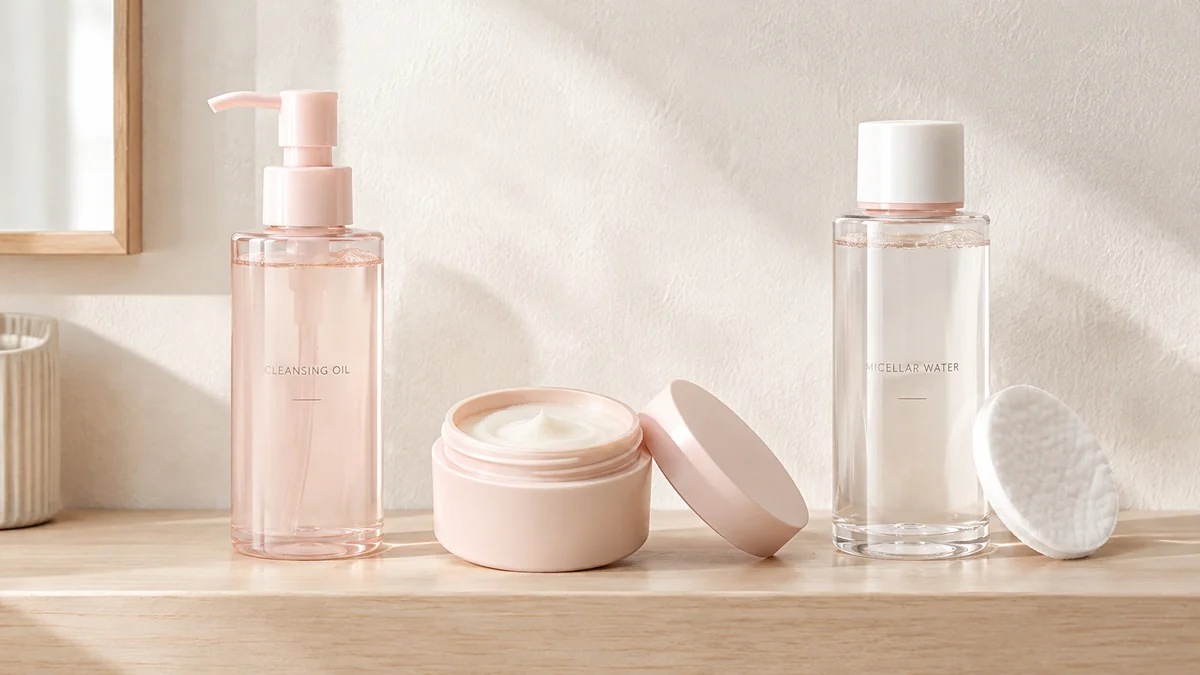
Step 1 Options: Lightweight Cleansing Oil vs Cleansing Balm vs Micellar Water
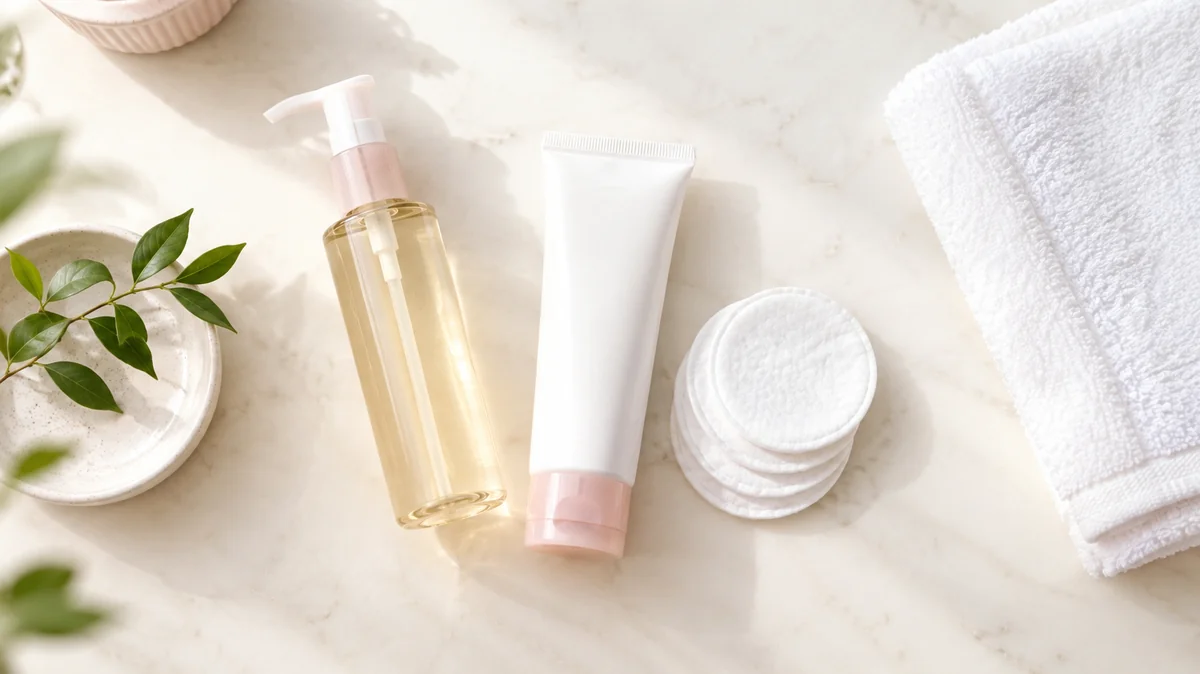
Cleansing oil is the classic starting point. It pours out like a light oil and turns milky the moment water touches it. For oily skin, look for one that feels thin rather than heavy and that rinses away without leaving a slick layer behind. Most oily-skinned beginners find oils the easiest to learn with, mostly because they spread fast and behave predictably.
A well-known beginner option is DHC Deep Cleansing Oil, which has been around forever and is easy to find in most countries. Formulas do change over the years, so read the current ingredient list before you buy instead of trusting an old review.
Cleansing balm starts as a solid, almost like soft butter in a tub, and melts into an oil on warm skin. Balms are brilliant at heavy makeup and stubborn sunscreen. The trade-off is rinsing. Some balms take more work to wash off, and richer ones can feel like too much on oily skin. Plenty of people still love them. It is a texture preference as much as anything.
Banila Co Clean It Zero is the balm most beginners end up trying first, and it comes in lighter versions too. If you go this route, pick the one made for normal to oily skin and check the label.
Micellar water is the lazy-day option, and I mean that as a compliment. It is a watery liquid you sweep over your face with a cotton pad. Inside it are tiny cleansing molecules called micelles that grab oil and makeup. It is genuinely easy. It is also the weakest of the three. Light makeup and light sunscreen, fine. Waterproof mascara and a full face, not really. A lot of people also prefer rinsing after it, because left on the skin it can feel a bit sticky.
Bioderma Sensibio H2O and Garnier Micellar Water are the two names you will see everywhere, and both are beginner-friendly. As always, confirm the current formula on the brand’s own site.
Here is the honest comparison:
| Feature | Cleansing oil | Cleansing balm | Micellar water |
|---|---|---|---|
| Texture | Light liquid oil | Thick, melts to oil | Watery, light |
| Ease of rinsing | Easy, turns milky | Moderate, can feel slightly rich | Often best followed by a rinse |
| Beginner-friendliness | High | Medium to high | High, but best for light makeup |
| Good for waterproof makeup/sunscreen | Very good | Very good | Limited |
| Best for | Most oily beginners | Heavy makeup, dry patches | Light makeup days, travel |
Still stuck between them? Buy the lightweight cleansing oil. Decide later, once you know your skin better.
Step 2 Options: A Gentle, Low-pH Gel Cleanser (Ideally with Salicylic Acid)
Your second cleanser is water-based and, this part matters, gentle. Healthy skin sits slightly on the acidic side, roughly between the mid-4s and mid-5s on the pH scale. A low-pH cleanser, usually labeled somewhere around 4.5 to 6, respects that. A very alkaline wash does not, and your barrier notices the difference even if you do not.
Gel formulas suit oily skin well. They rinse clean and leave nothing behind. Whatever you buy, skip the ones that leave your face tight and squeaky. People call that feeling “clean,” but it’s really a warning sign.
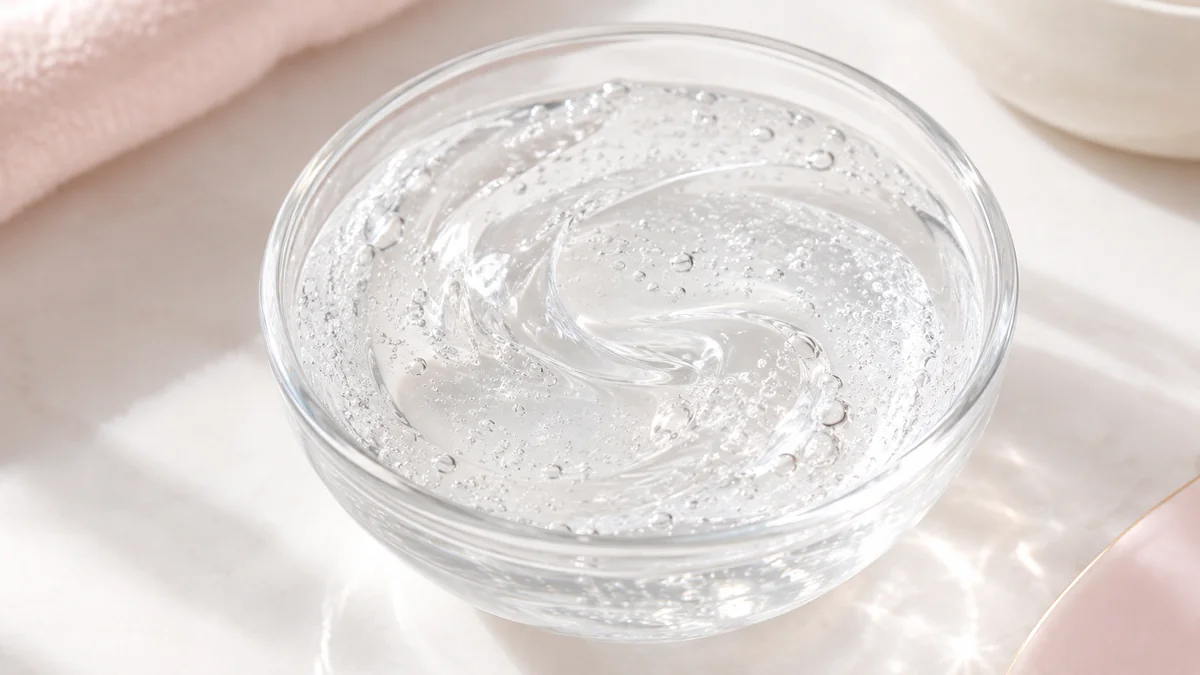
Two things worth looking for on the label:
Salicylic acid, also listed as BHA. It dissolves in oil, which means it can get into pores instead of just sitting on top of them. That is why oily, blackhead-prone skin tends to like it. In a cleanser it only touches your skin for about 30 seconds before you rinse, so it is usually much gentler than a leave-on BHA product. If your skin is on the sensitive side, start with it a few nights a week rather than every night.
And a mild formula overall. The words non-comedogenic on the label mean the product was formulated not to clog pores. Helpful, yes. A guarantee for your particular face, no. Nothing is.
Beginner-friendly examples people start with:
CeraVe Renewing SA Cleanser (contains salicylic acid)
Neutrogena Oil-Free Acne Wash (contains salicylic acid)
La Roche-Posay Effaclar Purifying Foaming Gel (a gel cleanser made for oily skin)
Availability and formulas differ between the US and the UK, and brands quietly reformulate things. Read the label in the shop, not just the reviews.
The Method, Step by Step
The whole thing takes three to four minutes, in the evening, after the day has done its worst to your face.
1. Start with dry hands and a dry face.
Do not wet your face first. This is the step everyone wants to skip and it genuinely matters. Water sitting on your skin blocks the oil cleanser from grabbing onto makeup and sunscreen properly.
2. Apply your first cleanser.
Two or three pumps of cleansing oil into your palm. For a balm, scoop out a pea-to-almond-sized amount and melt it between your fingers first. Micellar water people, soak a cotton pad and press it on your face instead of scrubbing with it.
3. Massage for a full 60 seconds.
A real 60 seconds. Count, or put a timer on. Gentle circles, nothing aggressive, and spend the extra time where stuff collects: nose, chin, forehead, hairline. Nearly every beginner rinses at 15 seconds because it feels done. It is not done. Fifteen seconds is not long enough for the oil to dissolve a day of sunscreen.
4. Emulsify with a splash of water.
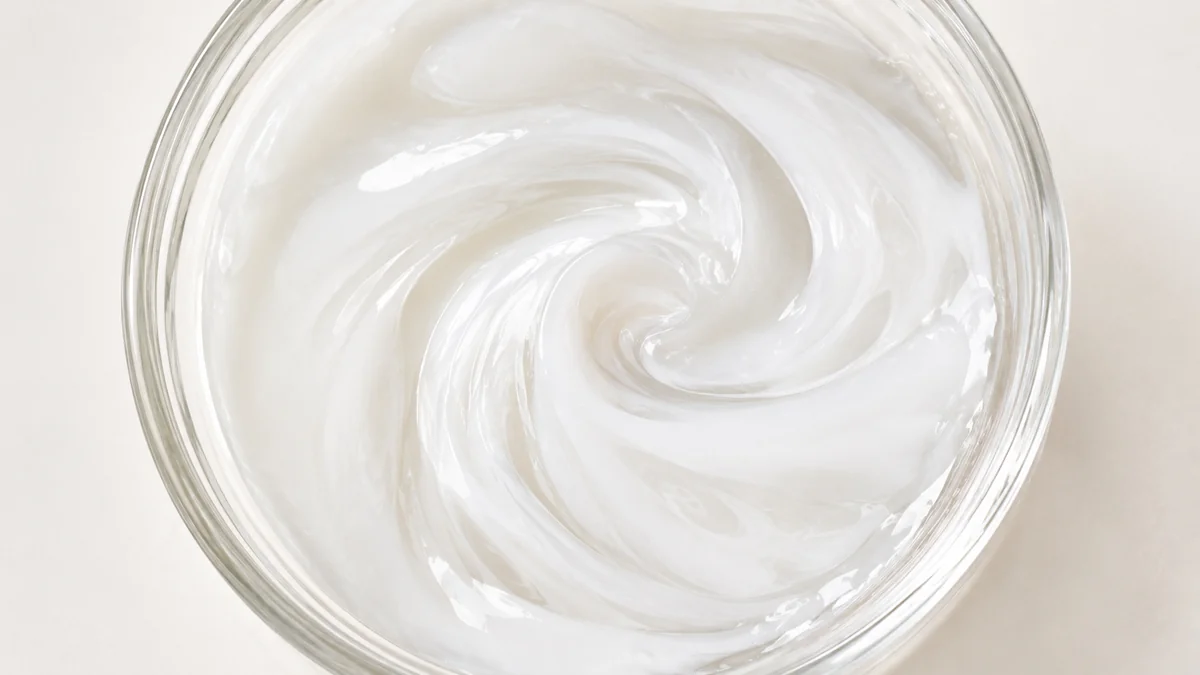
Wet your fingertips and massage again, lightly. The oil on your face should turn white and milky. That milky moment is called emulsifying, and it is the reason this oil rinses off instead of sitting on your skin. Give it 15 to 20 seconds, until it looks like thin milk.
5. Rinse properly with lukewarm water.
Fifteen to twenty seconds of rinsing, minimum. Run your fingers along your hairline, your jaw and around your nose and check for slippery patches, because those are exactly the places people miss. Lukewarm, not hot. Hot water feels satisfying and irritates your skin while it does it.
6. Second cleanse, about 30 seconds.
A coin-sized amount of your gel cleanser on damp skin. Massage gently, rinse well. Thirty seconds is enough. You already did the heavy lifting in step one.
7. Pat dry.
Clean towel, press, done. Dragging a towel across your face like you are polishing something helps nobody.
That is the whole routine. Everything else in your evening skincare comes after this, and if the order of serums and creams confuses you, this simple skincare layering order guide walks through it.
How Often Should Beginners Double Cleanse?
Evenings. For most people, evenings are the whole answer with double cleansing for oily skin. That is when your face is carrying the full day: sebum, sunscreen, makeup, city air.
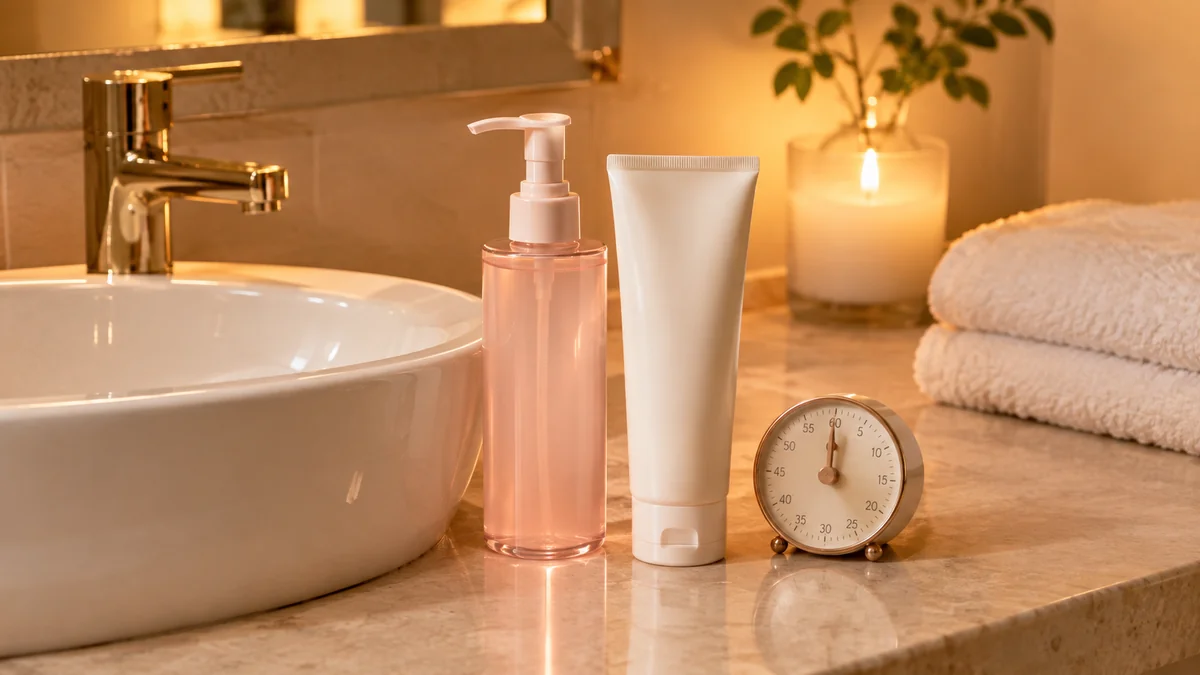
Mornings almost never need it. Overnight, your skin only produced a bit of oil and absorbed whatever you put on it before bed. A splash of water, or one gentle cleanse if you prefer, handles that fine. Doing the full double cleanse twice a day is simply too much for a lot of skin types, and skin that is over-cleansed tends to announce it.
You can also skip it some evenings. Bare-skin days, the stayed-home, no-makeup, barely-any-sunscreen days, one gentle cleanse is honestly enough. Your skin will tell you when you have overdone it. Tight, stingy, red, flaky around the mouth. Hear that, and cut back to once.
If you are building the rest of your evening routine around this, this night skincare routine shows where double cleansing slots in.
7 Beginner Mistakes with Double Cleansing for Oily Skin
When double cleansing for oily skin goes wrong, it is almost never the idea that failed. It is technique. Small things, done slightly wrong, every night. The good news is that every one of these is fixable in about ten seconds.
1. Starting on wet skin.
Already covered, but it is mistake number one for a reason. Wet face, weak first cleanse. Start dry.
2. Skipping the emulsify step.
Rinse oil straight off without the splash-of-water massage first and some of it stays behind as a film. A film traps debris. Trapped debris becomes clogged pores. Wait for the milky color. Every time.
3. Using coconut or olive oil straight from the kitchen.
I understand the appeal. It is cheap, it is already in the house, and the internet loves it. But cooking oils are not made to rinse off skin, and they do not emulsify. Coconut oil especially gets reported again and again for clogging pores on breakout-prone skin. Use a cleanser that was built to wash away.
4. A harsh, foamy second cleanser.
If your face squeaks afterward, that cleanser is too strong, full stop. Harsh second cleansers irritate skin, and irritated oily skin often responds by making more oil. Gentle gel. That is the whole fix.
5. Double cleansing twice a day.
Because once worked, twice feels like it should work better. It usually does not. Evenings only, unless your skin genuinely loves it, which most skin does not.
6. Scrubbing like it owes you money.
Pressure does not empty pores. It just makes skin red and angry. Slow, gentle, boring massage wins.
7. Lazy rinsing.
Leftover cleanser sitting along the hairline, the jawline and beside the nose is a classic, quiet cause of those little bumps that appear in a neat line and make no sense. Rinse longer than feels necessary. Then a few seconds more.
Fix those seven and you have fixed roughly everything that makes beginners quit in week two.
What Results to Expect
Real talk on timelines, because this is where people get disappointed and abandon their double cleansing for oily skin routine just as it was actually working.
Week 1: Your skin will probably just feel properly clean. Makeup and sunscreen come off fully, no tint left on the cotton pad, and mornings may look a little less greasy. Some people get a few small bumps in the first week or two while their skin adjusts, especially if the second cleanser has salicylic acid in it. A few small bumps is adjustment. Burning, stinging or a proper rash is not. If that happens, drop to a few nights a week, or stop entirely.
Weeks 3 to 4: This is where double cleansing for oily skin starts paying rent. Fewer new blackheads is the change people report most. The T-zone often looks calmer, and the midday shine tends to show up later, or less. The logic is boring, which is usually a good sign. Less buildup sitting in pores, and skin that is not being stripped and then panicking to replace its oil. Your mileage will vary. Hormones, diet, stress and the rest of your products all have a vote too.
Old blackheads, the ones that have lived on your nose for a year? They are not leaving in a week, whatever a product promises. Consistency over weeks is the unglamorous answer.
Do You Still Need Toner After?
No. Toner is optional, always was. If you like a hydrating toner, or a gentle exfoliating one, it goes after the second cleanse, and enjoy it. But nothing about double cleansing requires it. My actual advice for beginners: add nothing else for the first few weeks. One change at a time means when something helps or hurts, you know exactly what it was.
FAQs
Will double cleansing make my oily skin oilier?
Almost always the opposite. Done gently, double cleansing for oily skin removes buildup without stripping, and skin that is not stripped has no reason to panic-produce oil. It is the harsh, squeaky cleansers that tend to trigger that rebound shine.
Can I use micellar water as my only first cleanse?
Yes, on light days. When you are double cleansing for oily skin on a light-makeup, light-sunscreen day, micellar water handles the first cleanse fine. Heavy or waterproof products need a proper oil or balm first.
Cleansing oil or balm: which is better for beginners?
For double cleansing for oily skin, the oil is usually the easier start. It spreads faster, rinses cleaner, and there is less guessing about how much to use. Balms are lovely too, just slightly more work and slightly richer on the skin.
Which oil cleanser is safe for acne-prone skin?
There is no product anyone can honestly call safe for every face. What you can do: pick a lightweight oil, check that it is labeled non-comedogenic, patch test it on one area for a few days, and stop if your skin objects. Persistent acne belongs in front of a dermatologist, not a product label.
Can I skip the second cleanse?
On a bare-skin day, probably yes. On days with sunscreen, makeup, or a lot of sweat, the second cleanse helps wash away what the first one leaves behind, so keep it.
How long until my blackheads improve?
Most people who see improvement notice it around week three or four. Some sooner, some later, some not much at all. Give it a fair month before you judge it.
Can beginners double cleanse if they wear no makeup?
Yes, if you wear sunscreen or your skin is oily. Sunscreen alone is reason enough. If you wear neither makeup nor sunscreen and your skin is not oily, one gentle cleanse is plenty and simpler.
Is double cleansing okay every single night?
For most people, yes. If your skin starts feeling dry, red or irritated, pull back to a few nights a week, especially in the colder months when your skin is already struggling. This winter skincare routine has more on adjusting your routine when the season changes.
The Bottom Line
Double cleansing for oily skin is not complicated, whatever the internet tries to sell you. Two gentle products. A dry face. Sixty seconds of massage, done properly. The milky emulsify step. A rinse that takes longer than you want it to. Evenings only, to start.
Give it three to four weeks before you decide anything. Skin does not turn around in three days, and it does not need you to be perfect. It just needs you to be consistent.