Best iPhone Model in 2026: Complete Guide to Choosing the Right iPhone
Complete Guide to Choosing the Right iPhone
Choosing the best iPhone model in 2026 is more complicated than simply buying the newest number. Apple’s current lineup includes the iPhone Duo, iPhone 18 Pro and iPhone 18 Pro Max, iPhone Air, iPhone 17, iPhone 17e, and iPhone 16, giving buyers several different combinations of size, performance, cameras, battery life, and design to consider. Apple’s current iPhone page confirms these models as part of its lineup.
The right iPhone depends on what you actually need. A person who records professional video may value the advanced camera system on the iPhone 18 Pro, while someone who wants a thin and lightweight phone may be more interested in the iPhone Air. A general user may prefer the standard iPhone 17, while someone who wants a large foldable display has the iPhone Duo to consider. Finding the best iPhone model in 2026 starts with understanding which features matter most to you.
This guide focuses on the current 2026 iPhone lineup, using Apple’s published specifications and announcements as the primary sources. Because prices, availability, carrier offers, and regional configurations can change, those details should always be checked for the country where you intend to buy.
Table of Contents
Which iPhone Is the Best in 2026?
Your priorities are the biggest factor when deciding on the best iPhone model for your needs. There is no single iPhone that is objectively the best for every person. Apple’s current lineup is designed around different priorities, so the best choice depends on your budget and how you use your phone.
If you want Apple’s newest traditional high-end iPhone, the iPhone 18 Pro and iPhone 18 Pro Max are the current Pro models. Apple says they introduce its latest Pro camera system, the A20 Pro chip, improved performance, and major battery-life improvements. The iPhone 18 Pro models also run iOS 27 and include Apple Intelligence and Siri AI features.
The iPhone Duo takes a different approach. It is Apple’s first foldable iPhone and has a 7.6-inch inner OLED display when opened and a 5.4-inch outer display when closed. It also uses Apple’s A20 Pro chip.
The iPhone Air focuses on a thin and lightweight design. Apple lists it at 5.64mm thick and 165 grams, with a 6.5-inch OLED display and ProMotion technology with adaptive refresh rates up to 120Hz. It uses the A19 Pro chip.
For buyers who want a more conventional iPhone, the iPhone 17 offers a 6.3-inch OLED display, ProMotion up to 120Hz, an A19 chip, 256GB or 512GB storage, and an IP68 rating.
Best iPhone for Most General Users
For general users, the iPhone 17 is a sensible model to consider because it combines a current-generation A19 chip with a 6.3-inch OLED display, ProMotion up to 120Hz, 256GB or 512GB storage, and IP68-rated water and dust resistance.
That specification set covers the needs of many everyday smartphone activities, including web browsing, messaging, photography, video calls, streaming, navigation, social media, and gaming. Whether it is the right choice for you still depends on factors such as price, preferred size, camera requirements, and whether you want Pro-level features. For many people, the best iPhone model will be the one that offers the right balance of performance, features, and price.
One advantage of choosing a standard model is that you can focus your budget on the features you are most likely to use. If advanced photography controls, professional video formats, or the largest possible display are not important to you, moving to a Pro or foldable model may not be necessary.
Best iPhone for Photography and Video
Choosing the best iPhone model for photography requires looking beyond the camera megapixel count. If photography and video are your main priorities, the iPhone 18 Pro and iPhone 18 Pro Max have Apple’s newest Pro camera system.
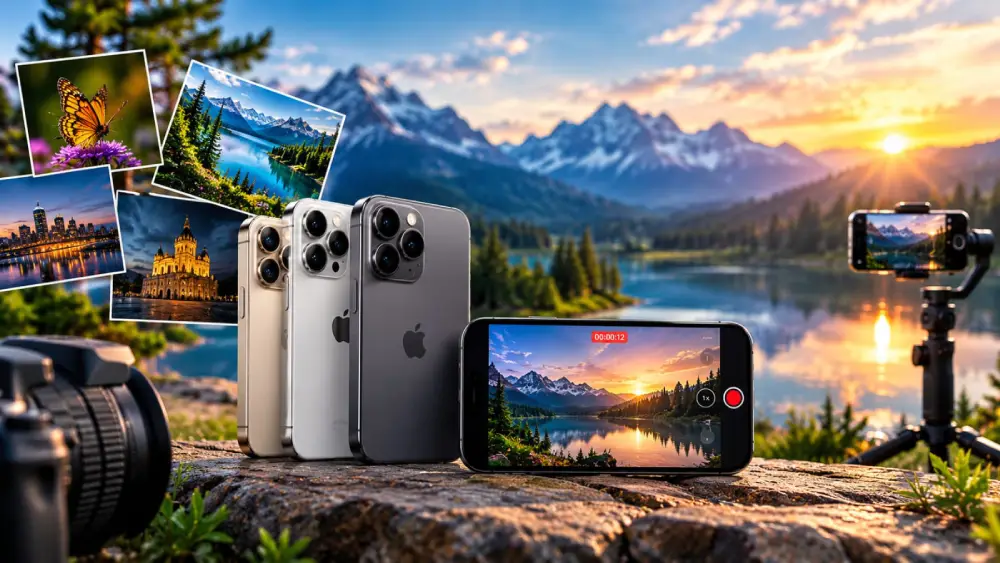
Apple’s current iPhone 18 Pro page lists a 48MP Fusion Main camera with variable aperture, a 48MP Fusion Ultra Wide camera, and a 48MP Fusion Telephoto camera. The system supports up to 8x optical-quality zoom and includes new Pro controls.
The variable-aperture Main camera can automatically adjust the aperture for lighting and depth-of-field effects. Apple lists four aperture settings on the Main camera: f/1.48, f/1.8, f/2.8, and f/4.0. Apple also says the system can provide improved low-light performance at the widest aperture.
For video creators, Apple’s specifications also list features such as 4K Dolby Vision recording, Cinematic mode, ProRes video, ProRes RAW, Apple Log 2, and other professional video capabilities on the iPhone 18 Pro models.
These features make the Pro models particularly relevant to photographers, videographers, and creators who will actually use advanced camera controls.
iPhone Models Available in 2026
The best iPhone model can be different for each type of buyer. Apple’s current U.S. iPhone shopping page lists the iPhone Duo, iPhone 18 Pro and iPhone 18 Pro Max, iPhone Air, iPhone 17, iPhone 17e, and iPhone 16 as its current models. Apple’s availability and pricing can vary by country, so shoppers should check their regional Apple website before purchasing.
Each model serves a somewhat different purpose. Instead of viewing the lineup as a simple progression where the most expensive phone is automatically the right choice, it is more useful to compare the actual features that matter to you.
iPhone 18 Pro and iPhone 18 Pro Max
For users who need advanced features, the best iPhone model may come from Apple’s Pro range. The iPhone 18 Pro and iPhone 18 Pro Max are Apple’s current Pro models.
Both use the A20 Pro chip and offer a 48MP Fusion camera system with variable aperture. The iPhone 18 Pro has a 6.3-inch OLED display, while the iPhone 18 Pro Max has a 6.9-inch OLED display. Both models support ProMotion technology.
Apple lists storage options from 256GB to 2TB for both Pro models. The iPhone 18 Pro weighs 211 grams, while the iPhone 18 Pro Max weighs 249 grams.
Battery performance is another important difference. Apple rates the iPhone 18 Pro for up to 36 hours of video playback, while the iPhone 18 Pro Max is rated for up to 45 hours of video playback under Apple’s testing conditions.
That does not mean every user will achieve those exact numbers. Battery life varies according to settings, network conditions, usage, and other factors.
iPhone Duo
The iPhone Duo is Apple’s first foldable iPhone. When opened, it has a 7.6-inch inner OLED display; when closed, it has a 5.4-inch outer OLED display. Both displays support ProMotion with adaptive refresh rates up to 120Hz.
The phone uses the A20 Pro chip and offers 256GB, 512GB, 1TB, and 2TB storage options. Apple’s specifications list a 254-gram weight when open.
Apple says the large inner display is designed to provide a larger canvas for activities such as viewing content, gaming, and multitasking.
The camera system includes a 48MP Fusion Main camera, a 48MP Fusion Ultra Wide camera, and a 12MP optical-quality 2x Telephoto option. Apple’s specifications also list 48MP macro photography.
Apple announced that iPhone Duo pre-orders begin October 16, 2026, with availability beginning October 23, 2026.
iPhone Air
For buyers who prioritize portability, the best iPhone model may be a lighter option. The iPhone Air is designed around a thin and lightweight form factor.
Apple lists its thickness at 5.64mm and its weight at 165 grams. It has a 6.5-inch Super Retina XDR OLED display with ProMotion technology and adaptive refresh rates up to 120Hz.
An important specification is the A19 Pro chip. The earlier version of this article described the chip only as a “current-generation platform,” but Apple’s technical specifications explicitly identify it as A19 Pro.
The iPhone Air has a 48MP Fusion camera system. Apple lists a 48MP Fusion Main camera that also enables a 12MP optical-quality 2x Telephoto option.
Battery life is rated by Apple at up to 27 hours of video playback and up to 22 hours of streamed video playback under Apple’s testing conditions.
For buyers who place a high value on low weight and a thin design, these specifications may make the iPhone Air particularly interesting.
iPhone 17
Apple lists the iPhone 17 at 177 grams and gives it an IP68 rating under IEC standard 60529. The device also supports Apple Intelligence and Siri AI according to Apple’s current technical specifications.
The best iPhone model for everyday use does not necessarily need to be the most expensive model. The iPhone 17 has a 6.3-inch Super Retina XDR OLED display and supports ProMotion with adaptive refresh rates up to 120Hz. It uses the A19 chip and comes with 256GB or 512GB storage.
For someone who wants a current iPhone with a high-refresh-rate OLED display but does not specifically need the Pro camera system or foldable design, the iPhone 17 provides a straightforward option.
iPhone 17e
The iPhone 17e sits below the standard iPhone 17 in Apple’s current lineup.
Apple lists a 6.1-inch Super Retina XDR OLED display, an A19 chip, 256GB or 512GB storage, and IP68 water and dust resistance.
Its camera system includes a 48MP Fusion Main camera that also enables a 12MP 2x Telephoto option. Apple lists support for 4K Dolby Vision video recording at up to 60 frames per second.
Unlike the iPhone 17, Apple’s published specifications for the 17e do not list ProMotion. Its display specifications instead describe the 6.1-inch OLED panel without the ProMotion specification shown on the iPhone 17 page.
That distinction is important when comparing the two models.
iPhone 16
The iPhone 16 remains part of Apple’s current lineup.
Apple’s specifications identify the A18 chip, a 48MP Fusion Main camera, a 12MP Ultra Wide camera, Camera Control, and an IP68 rating.
The iPhone 16 therefore remains relevant for buyers who find it at an attractive price, particularly if they do not need the newer display, camera, processor, or design features found on the newer models.
Because prices and promotions change, whether an iPhone 16 represents good value should be evaluated using its current price, not its original launch price.
IPhone Comparison Table
Comparing the specifications can make it easier to identify the best iPhone model for your personal needs.
| Model | Display | Chip | Main camera information | Storage options |
|---|
| iPhone 18 Pro Max | 6.9-inch OLED, ProMotion | A20 Pro | 48MP Pro Fusion system with variable aperture | 256GB, 512GB, 1TB, 2TB |
| iPhone 18 Pro | 6.3-inch OLED, ProMotion | A20 Pro | 48MP Pro Fusion system with variable aperture | 256GB, 512GB, 1TB, 2TB |
| iPhone Duo | 7.6-inch inner + 5.4-inch outer OLED, ProMotion | A20 Pro | 48MP Dual Fusion system | 256GB, 512GB, 1TB, 2TB |
| iPhone Air | 6.5-inch OLED, ProMotion | A19 Pro | 48MP Fusion Main + 2x optical-quality Telephoto | 256GB, 512GB, 1TB |
| iPhone 17 | 6.3-inch OLED, ProMotion | A19 | Current-generation Fusion camera system | 256GB, 512GB |
| iPhone 17e | 6.1-inch OLED | A19 | 48MP Fusion Main + 2x Telephoto | 256GB, 512GB |
| iPhone 16 | OLED | A18 | 48MP Fusion Main + 12MP Ultra Wide | Check current regional configuration |
The specifications above are based primarily on Apple’s current technical-specification pages.
How to Choose the Best iPhone for Your Needs
There are several factors to consider before deciding which best iPhone model fits your lifestyle. The easiest way to choose an iPhone is to start with your actual usage instead of the model number.
Ask yourself a few simple questions. Do you take lots of photos? Do you record video regularly? Do you need a large screen? Do you prefer a lightweight phone? Do you need several terabytes of storage? Or do you mainly use messaging, social media, browsing, streaming, and everyday apps?
Your answers can narrow the choices quickly.
Best iPhone for Everyday Use
If your smartphone is mainly used for communication, browsing, social media, streaming, photography, navigation, and ordinary apps, you may not need Apple’s most expensive model.
The iPhone 17 provides a combination of a 6.3-inch OLED display, ProMotion up to 120Hz, A19 processing, 256GB or 512GB storage, and IP68 protection.
The iPhone 17e is another option to investigate if you want an A19-powered iPhone with 256GB or 512GB storage and a 48MP Fusion camera, but do not specifically require the ProMotion display listed for the iPhone 17.
The final decision should depend on the current price difference and the features you actually value.
Best iPhone for Content Creators
For creators, the best iPhone model should match their camera, video, storage, and performance requirements. Content creators should pay close attention to camera controls, video formats, storage, battery performance, and display quality.
The iPhone 18 Pro models offer Apple’s most advanced Pro camera system, including a variable-aperture 48MP Fusion Main camera and 48MP Ultra Wide and Telephoto cameras. Apple’s technical specifications also list professional video capabilities, including ProRes, ProRes RAW, Apple Log 2, and 4K Dolby Vision recording.
Storage is particularly important for people who record a lot of video. The iPhone 18 Pro models are available with up to 2TB of storage, which provides substantially more local capacity than the 256GB base configuration.
That does not mean every creator needs 2TB. Someone who regularly transfers footage to a computer or cloud storage may have different requirements from someone who keeps large video libraries on the phone.
Best iPhone for a Large Screen
If screen size is one of your main priorities, the iPhone Duo provides the largest display experience in Apple’s current lineup. Its inner display measures 7.6 inches diagonally, while the outer display measures 5.4 inches. Both support ProMotion up to 120Hz.
The iPhone 18 Pro Max has a conventional 6.9-inch OLED display, making it another option for people who want a large screen without choosing a foldable design.
The iPhone Air offers a 6.5-inch OLED display in a much thinner and lighter body than the Pro Max, according to Apple’s published dimensions and weight.
Best iPhone for Portability
A lightweight design can be an important factor when choosing the best iPhone model. If carrying a lightweight phone is important, the iPhone Air deserves attention. At 165 grams and 5.64mm thick, it is considerably focused on Portability while still offering a 6.5-inch OLED display and A19 Pro chip.
The practical advantage of a lighter phone is simple: it can be easier to carry and handle throughout the day. However, some users may prefer a heavier model if they prioritize battery life, camera hardware, or a larger conventional Pro design.
What About Older iPhone Models?
A previous-generation iPhone can still be worth considering when the current price makes sense.
The important point is to compare the current selling price and features, not simply the age of the phone. An older device that is heavily discounted can be more attractive than a newer model with features you will not use.
The iPhone 16, for example, still has an A18 chip, a 48MP Fusion Main camera, a 12MP Ultra Wide camera, Camera Control, and IP68 protection.
That makes it important to look at the complete specification sheet before assuming that an older model is unsuitable.
Buying a Used or Refurbished iPhone
If you are buying a used or refurbished iPhone, specifications are only part of the equation.
Check the phone’s battery health, storage capacity, physical condition, repair history, warranty or coverage status, and seller reputation. Two phones with the same model number can have very different conditions depending on how they were used and whether they have previously been repaired.
Apple provides tools and support information for checking coverage and managing iPhone battery-related information. Buyers should also verify that the specific device they are purchasing matches the advertised model and configuration.
For imported phones, also check cellular compatibility, SIM/eSIM requirements, and local network support before paying.
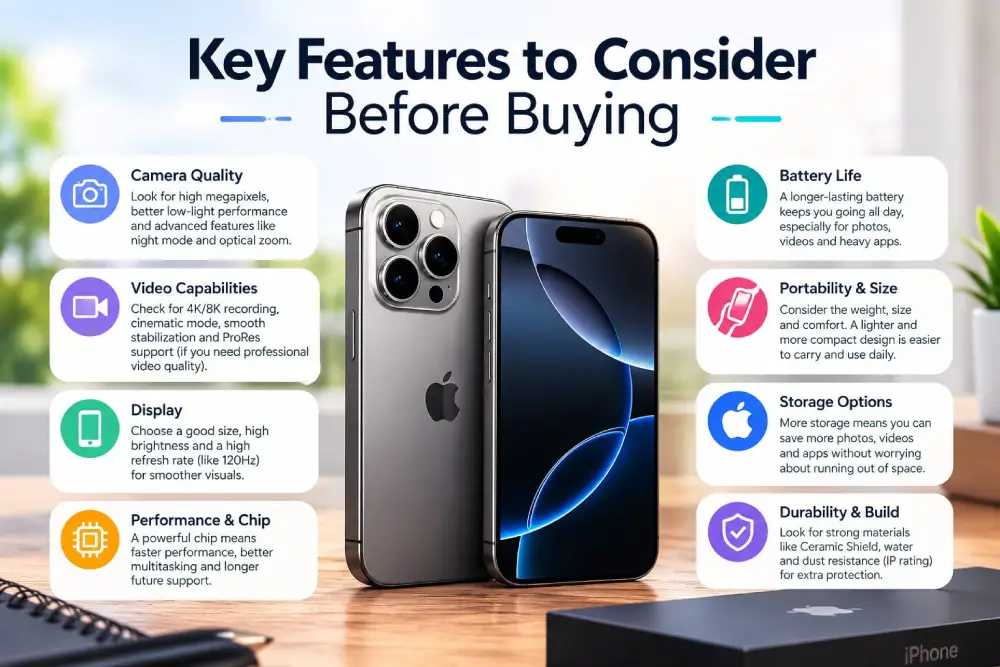
Key Features to Consider Before Buying
Display
The display affects almost every interaction with your phone. If you spend significant time reading, watching videos, browsing websites, or editing photos, screen size and refresh rate can be important.
The iPhone 17, iPhone Air, iPhone 18 Pro models, and iPhone Duo all offer ProMotion according to Apple’s specifications, although their screen sizes and designs differ.
The iPhone 17e’s published specifications do not list ProMotion, so buyers who specifically want Apple’s adaptive high-refresh-rate display should pay attention to this distinction.
Camera
Do not judge an iPhone camera only by megapixel count.
Look at the complete camera system, including the available lenses, stabilization, zoom options, video recording capabilities, and software features. For example, the iPhone 18 Pro models have three 48MP rear cameras and variable aperture on the Main camera, while the iPhone 17e uses a 48MP Fusion Main system with a 12MP 2x Telephoto option.
The right camera system depends on what you photograph.
Battery Life
Battery specifications should be compared using the manufacturer’s stated testing measurements rather than assumptions based only on phone size.
Apple rates the iPhone 18 Pro Max for up to 45 hours of video playback, compared with up to 36 hours for the iPhone 18 Pro. The iPhone Air is rated for up to 27 hours of video playback.
Actual battery life varies with usage and settings, so these figures should be treated as standardized manufacturer test results rather than a guarantee of daily usage.
Storage
Storage is another feature that is easy to overlook. The iPhone 18 Pro, iPhone 18 Pro Max, and iPhone Duo offer configurations reaching 2TB, while the iPhone Air goes up to 1TB. The iPhone 17 and 17e are available with 256GB and 512GB options according to Apple’s specifications.
If you record lots of high-resolution video or keep a large offline media library, additional storage can be useful.
Weight and Size
Physical dimensions matter because your phone is something you carry and hold every day. The iPhone Air weighs 165 grams, while the iPhone 17 weighs 177 grams, the iPhone 18 Pro weighs 211 grams, and the iPhone 18 Pro Max weighs 249 grams. The iPhone Duo weighs 254 grams when open, according to Apple’s specifications.
Those differences may seem small on paper, but they can be noticeable when a phone is used for long periods.
Software and Apple Intelligence
Apple’s current iPhone lineup uses iOS 27, and Apple’s current specifications describe Apple Intelligence and Siri AI features on the newer models.
The availability of individual Apple Intelligence features can depend on language, region, device, and other requirements, so readers should check Apple’s current documentation if a particular AI feature is important to their purchase decision. The best iPhone model ultimately depends on the combination of features you value most.
Conclusion
The best iPhone model in 2026 depends on what you want from your phone rather than which model has the highest number. The iPhone 18 Pro and iPhone 18 Pro Max are Apple’s current high-end Pro models, using the A20 Pro chip and featuring a 48MP Pro Fusion camera system with variable aperture. The Pro Max also has a 6.9-inch display and Apple’s published rating of up to 45 hours of video playback.
The iPhone Duo is the choice for buyers interested in Apple’s first foldable design, with a 7.6-inch inner display, 5.4-inch outer display, A20 Pro chip, and up to 2TB of storage. Apple says pre-orders begin October 16, 2026, with availability beginning October 23. The iPhone Air focuses on a thin, lightweight design while offering a 6.5-inch OLED display, ProMotion up to 120Hz, and the A19 Pro chip.
The iPhone 17 provides a 6.3-inch OLED display, A19 chip, ProMotion up to 120Hz, and 256GB or 512GB storage, while the iPhone 17e offers an A19 chip, 6.1-inch OLED display, and 256GB or 512GB storage. The iPhone 16 remains another option and uses the A18 chip with a 48MP Fusion Main camera and 12MP Ultra Wide camera.
Before publishing or buying, check the current price, local availability, storage configuration, carrier compatibility, and regional features for your market. Apple’s online store shows that pricing and availability are market-specific, and some specifications or services can vary by region.
Rather than paying for the most expensive specification sheet, choose the model whose display, camera, storage, battery performance, size, and software features match the way you actually use your phone. Understanding the differences between the available models makes choosing the best iPhone model much easier.
FAQS
What is the best iPhone model in 2026?
There is no single model that is best for every user. The iPhone 18 Pro and 18 Pro Max provide Apple’s current Pro-level hardware, the iPhone Duo offers a foldable design, the iPhone Air focuses on thinness and weight, and the iPhone 17 provides a more conventional current iPhone configuration.
Is the iPhone 18 Pro Max better than the iPhone 18 Pro?
Both models use the A20 Pro chip and share Apple’s Pro camera system. The main differences include physical size, display size, weight, and battery performance. Apple rates the iPhone 18 Pro Max for up to 45 hours of video playback compared with up to 36 hours for the iPhone 18 Pro.
Is the iPhone 17 still worth considering in 2026?
Yes, it remains part of Apple’s current lineup. It has an A19 chip, a 6.3-inch OLED display with ProMotion up to 120Hz, 256GB or 512GB storage, and an IP68 rating. Whether it is the right purchase depends on its current price and the features you need.
What is special about the iPhone Air?
The iPhone Air emphasizes a thin and lightweight design. Apple lists it at 5.64mm thick and 165 grams, with a 6.5-inch OLED display, ProMotion up to 120Hz, and an A19 Pro chip.
What is the iPhone Duo?
The iPhone Duo is Apple’s first foldable iPhone. It has a 7.6-inch inner OLED display and a 5.4-inch outer OLED display, both supporting ProMotion up to 120Hz. It uses the A20 Pro chip and is available with storage options up to 2TB.
Which iPhone is best for photography?
If you want Apple’s newest Pro camera technology, the iPhone 18 Pro models are the relevant models to examine. They feature a 48MP Fusion Main camera with variable aperture, 48MP Ultra Wide and Telephoto cameras, and professional camera and video controls.
Should I buy the most expensive iPhone?
Not necessarily. The most expensive model has features that may be unnecessary for someone who mainly uses a phone for messaging, browsing, streaming, social media, calls, and casual photography. Compare the features you actually need with the current price before making a decision.